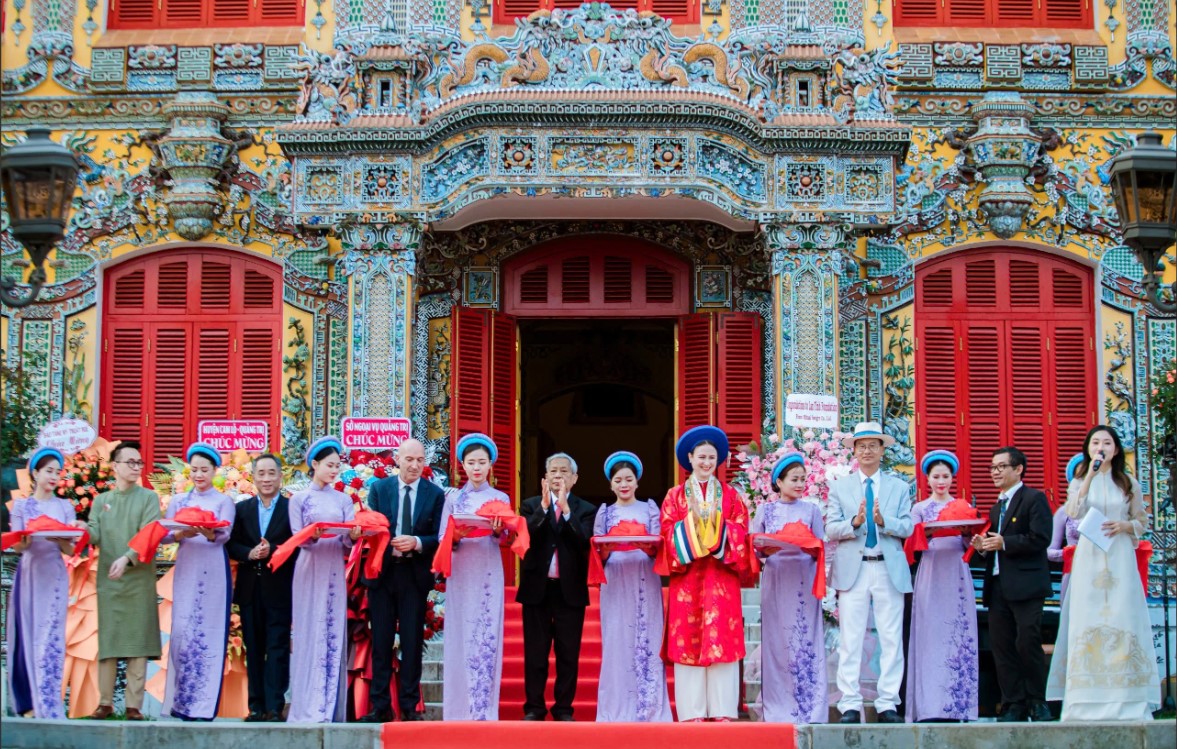
On the afternoon of March 24, the exhibition titled “Troi, Non, Nuoc ( sky, mountain and water) Allusive Panorama” grand opened at Kien Trung Palace, located within the Hue Imperial City. The exhibition is organized by Art Republik Vietnam magazine in collaboration with the Hue Monuments Conservation Centre and the French Institute in Vietnam.
The event coincides with Hue’s preparations for the National Tourism Year 2025 and Hue Festival 2025, commemorating the 50th anniversary of the Liberation of Hue (March 26, 1975 – March 26, 2025), and celebrating Hue’s new status as a centrally governed city.
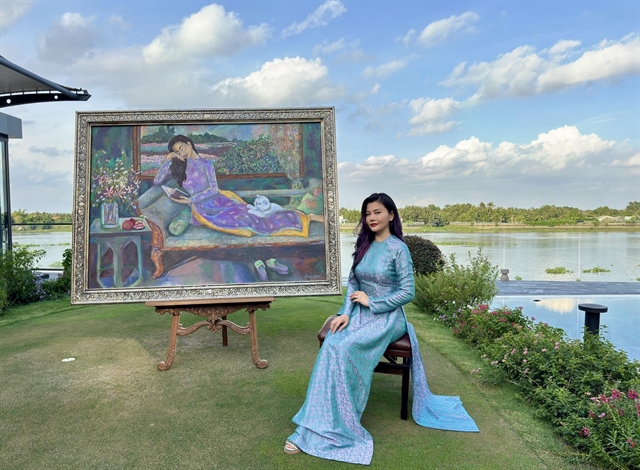
For the first time, 21 valuable paintings by Emperor Ham Nghi, gathered from 10 private collections, are officially on public display from March 25 to April 6, welcoming art lovers from across the country.
Using the pseudonym “Tu Xuan” (meaning “Son of Spring”), Emperor Ham Nghi entrusted to art his nostalgia for his homeland and his aspirations beyond time. Over the past 15 years, his paintings have appeared on the French art market, mainly from private collections belonging to descendants of friends to whom he had gifted his works. From there, Vietnamese collectors gradually discovered and repatriated his paintings.
The exhibition, “Troi, Non, Nuoc Allusive Panorama,” not only introduces the public to the artistic legacy of an exiled emperor, but also creates a dialogue between past and present — where colors and brushstrokes convey the inner reflections of a king who expressed his deepest emotions through painting.
The exhibited works are the result of more than a year of dedicated research, authentication, appraisal, and meticulous restoration according to international standards. The project was led by curator Ace Lê and the Lân Tinh Foundation, in collaboration with Dr. Amandine Dabat — a fifth-generation descendant of Emperor Ham Nghi — along with leading art institutions and partners both in Vietnam and abroad.
Displayed on the newly restored second floor of Kien Trung Palace, each painting reveals a fragment of Emperor Ham Nghi’s inner world.
For example, Vue de la résidence d’El Biar (View of the Residence in El Biar) depicts the place where he once lived in Algiers — a peaceful corner during his exile. Landscape with Cypress Tree (Menthon-Saint-Bernard) from 1906 portrays a French countryside scene he visited during his travels, expressing the intersection between lived reality and longing for his homeland. Meanwhile, Forest Edge (Lake Geneva) from 1920 carries a contemplative tone, with deep hues reflecting the artist’s emotional response to the vastness of nature.
The routine of Return to the Former Imperial Capital
Mr. Hoang Viet Trung, Director of the Hue Monuments Conservation Centre, expressed gratitude and appreciation to Art Republik magazine, Dr. Amandine Dabat — art historian and fifth-generation descendant of Emperor Ham Nghi — and the French Institute in Vietnam for their effective collaboration.
“The return of artworks created by Emperor Ham Nghi to Kien Trung Palace is not only an emotional reunion between art and history, but also a profound tribute to a king who, though exiled, never lost his connection to his homeland. We hope the exhibition will help the public better understand the life and artistry of this patriotic emperor,” Mr. Trung said.
The exhibition marks an important milestone in heritage preservation and serves as a cultural bridge between two nations, vividly demonstrating the enduring cultural cooperation between France and Vietnam.
Mr. Franck Bolgiani, Cultural Attaché of the French Embassy, Director of the French Institute in Hanoi and Deputy Director of the French Institute in Vietnam, noted that Emperor Ham Nghi was not only a monarch but also one of the first Vietnamese artists formally trained in Western painting.
“By combining French academic techniques with a deep love for the nature and culture of his homeland, he created highly distinctive works filled with emotion and nostalgia. Each landscape painting is a subtle self-narrative of loneliness, resistance, and the resonant beauty of the Vietnamese soul. Through this exhibition, we have the opportunity to appreciate the artistic language of an emperor who, even in exile, found ways to revive the memories and culture of his native land,” Bolgiani shared.
As part of the opening ceremony, Art Republik also introduced its Issue No. 7, themed “Vision from the Midpoint.” The issue offers fresh, multidimensional perspectives on painting and art, with a special focus on the journey of researching, curating, and creating the distinctive exhibition space for “Troi, Non, Nuoc | Allusive Panorama.”
Speaking further about Emperor Ham Nghi’s artistic talent, curator and art researcher Ace Lê — also Editor-in-Chief of Art Republik — emphasized that Ham Nghi’s paintings represent a unique fusion of artistic mastery and patriotism. Through them, he conveyed both his longing for his homeland and his subtle resistance to oppression during exile.
“The former emperor painted landscapes, but in truth he painted emotions — both personal and collective. That is why I chose the title ‘Troi, Non, Nuoc Allusive Panorama,’ inspired by the poetry of Ba Huyen Thanh Quan. Ham Nghi was a pioneering and exemplary figure in the cross-cultural dialogue between Asian and European art — absorbing influences without dissolving his identity, proudly upholding his own cultural banner. In a Western- and market-oriented art economy, Ham Nghi and his works were long covered in dust. Now is the time for us to retell his story in our own language and from an indigenous perspective — just as the emperor himself did more than a century ago,” Ace Lê stated.